
EDbN holds the closing ceremony of the ICF Core Set for Deafblindness Project
After four years of tireless work, the Catalan Association for Deafblind People (APSOCECAT), acting as the delegation of the European Deafblind Network (EDbN) in Catalonia, has successfully concluded the ICF Core Set for Deafblindness project. The ceremony hosted political figures that take part in disability policies in Catalonia.
The ICF Core Set for Deafblindness project, initiated four years ago, has concluded in Barcelona. It involved four main studies worldwide aimed at identifying and establishing standardised indicators to define deafblindness within the framework of the WHO.
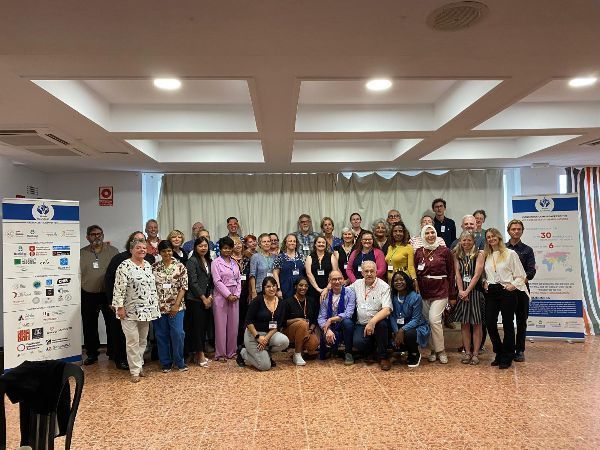
The consensus conference held on October 7 and 8 of this year was a resounding success, marking a significant step forward for the deafblind community. A total of 27 professionals from across the globe, all experts in deafblindness, attended the conference to determine the set of codes to be submitted to the WHO.
This conference played a key role in achieving global recognition of deafblindness as a unique disability within the healthcare sector. It will also aid in defining and improving the quality of specialised services essential for individuals with deafblindness.
The primary goal of the two-day conference was to establish a universally applicable and accepted set of codes within the ICF framework for deafblindness. Additionally, it served as a platform to foster collaboration and consensus among experts from various disciplines, researchers, clinicians, and individuals with deafblindness, ensuring a comprehensive perspective.
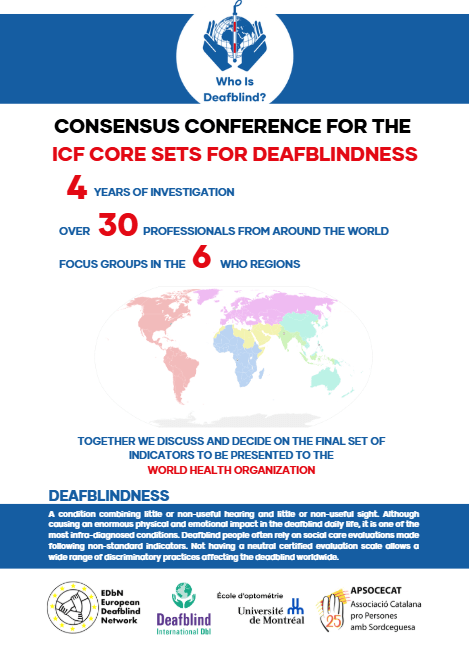
On October 7 and 8, the Calafont Hotel in Salou hosted the conference, during which scientific evidence, clinical expertise, and personal experiences were critically reviewed to develop the Core Sets. These sets aim to reflect the most relevant aspects of functioning and disability in deafblindness.
Following the consensus conference, an additional day (October 9) was dedicated to an institutional event, providing an excellent opportunity to launch the dissemination phase of the project’s outcomes.
The conference was opened by Mr Ricard López, President of APSOCECAT and co-organiser of the project, who explained how the project, endorsed by the WHO, was validated for a disability like deafblindness.
Dr Walter Wittich, the project’s scientific leader, detailed the methodology and phases of the project, highlighting the challenges posed by its complexity.
Mr Mirko Baur, President of Deafblind International, emphasised the importance of categorising indicators of deafblindness and their future applications from a global point of view.
For the representation of the families involved in the project, Ms Hellen Shakele from Zambia shared her experiences participating in focus groups and the consensus conference.
Presence of Political Authorities
Many political representatives in the disability sector attended the second part of the event.
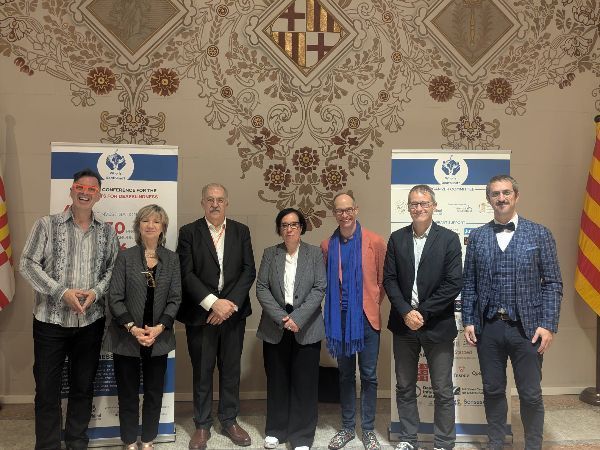
Ms Gemma Pifarré, Head of the Department of Accessibility Promotion and Barrier Removal at the Government of Catalonia; Mr Josep Muñoz Luque, Manager of Social Services at the Provincial Deputation of Barcelona; and Mr Raül Serra, Coordinator of Healthcare and Participation at the Catalan Government, expressed their gratitude to the project’s organisers and highlighted the importance of standardised codes for addressing the needs of all individuals with deafblindness across administrations.
Ms Raquel Gil Eiroá, Councillor for the Sants-Montjuïc district, also attended the event and expressed pride in seeing a local organisation spearheading an internationally significant project.
Organisation and participation
The global coordination of the conference and the development of its content were led by Ricard López (President of APSOCECAT and EDbN), Walter Wittich (principal researcher for Deafblind International, Canada), and Dr Sarah Granberg (Switzerland), an expert in developing International Classification of Functioning standards.
The logistical organisation of the event was managed by APSOCECAT’s team, who once again wish to express their gratitude to professionals such as occupational therapists, interveners, interpreters, and healthcare experts who attended the event on 9 October.
APSOCECAT also thanks the attendance of political leaders involved in formulating global healthcare strategies for sensory disabilities, whose contributions were crucial for the practical implementation of the Core Sets.
The conference has successfully defined indicators to determine whether a person most likely lives with deafblindness. The next step is to present these indicators to the WHO for official approval and disseminate the results globally to enable their practical application as soon as possible. The ultimate goal of this project is to provide tools that will enhance the development and autonomy of individuals with deafblindness.
For more information, visit the official website of the ICF Project for Deafblindness.